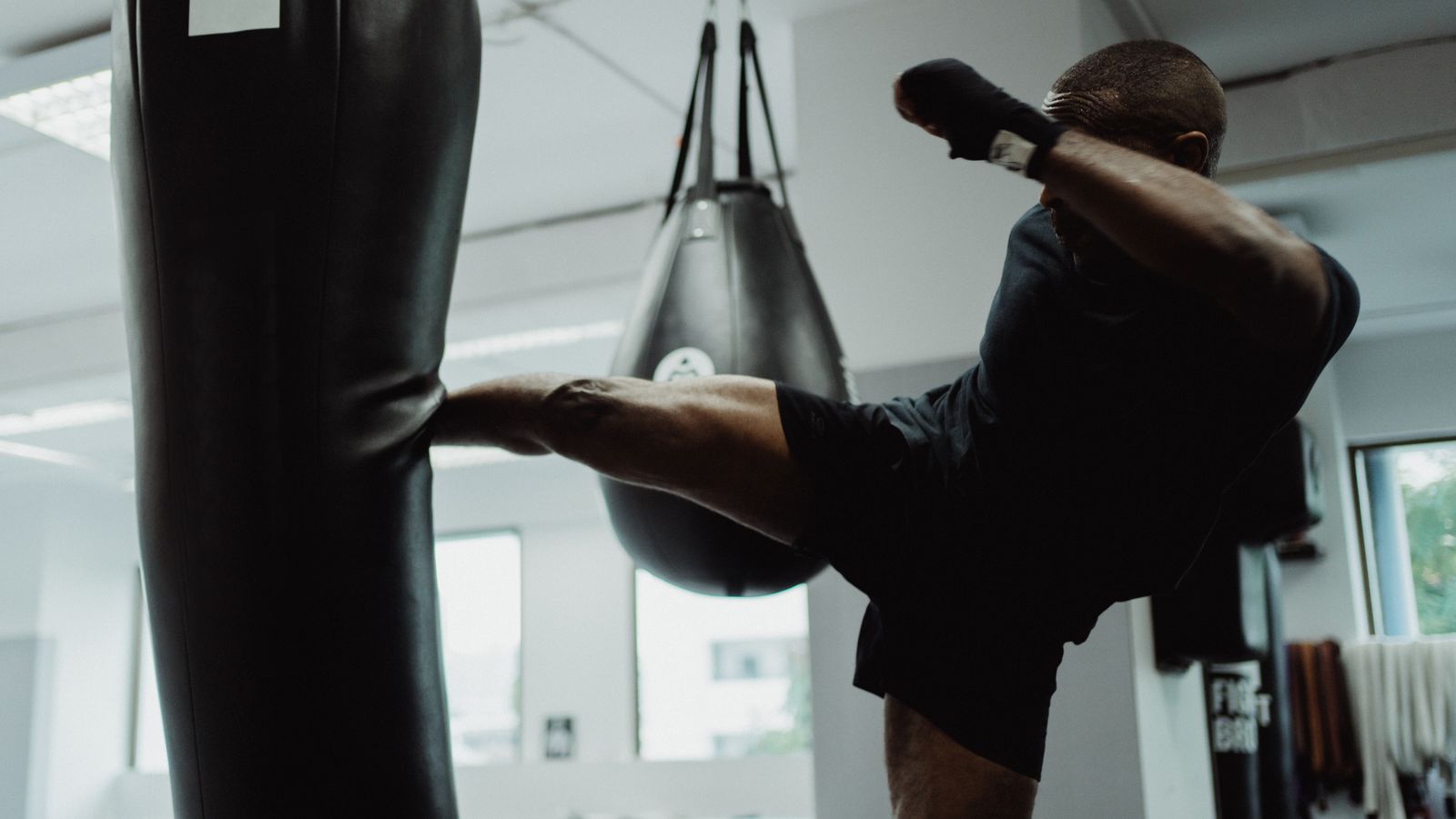
Muay Thai is known as the art of eight limbs because it uses eight striking surfaces: two fists, two elbows, two knees, and two shins. Most other striking arts use four or fewer. This is what makes Muay Thai uniquely complete, and it is the first concept every beginner should understand.
The eight limbs in one sentence each
- Two fists. Used like in boxing, for punches at long and medium range.
- Two elbows. Used in close range to cut, smash, and create damage in tight spaces.
- Two knees. Used in mid range and especially in the clinch, often the most punishing strike in Muay Thai.
- Two shins. Used to deliver roundhouse kicks, low kicks, body kicks, and head kicks.
The fists: the foundation
Muay Thai punching is similar to boxing but with a different weight distribution. Because Muay Thai stance is more upright (to allow checking kicks), punches have slightly less hip drive than boxing but more rotational power and faster recovery.
The four basic punches:
- Jab. Lead hand, straight forward. The most used strike in Muay Thai. Used to measure distance, set up other strikes, and disrupt the opponent.
- Cross. Rear hand, straight forward. The power punch. Maximum range, maximum damage per strike.
- Lead hook. Lead hand, curved horizontal. Used in close range and to catch opponents moving in or out.
- Rear uppercut. Rear hand, curved vertical. Used inside a guard or in clinch break-offs.
The elbows: the cutters
Elbows are unique to Muay Thai among major striking arts. They are used in close range where punches lose power. There are several primary elbows:
- Horizontal elbow. Slashing across the face. The most common elbow.
- Diagonal elbow. Downward at an angle, used after slipping a punch.
- Uppercut elbow. Driving upward into the chin from below.
- Spinning elbow. Rotating with the body for surprise power.
What makes elbows special is the surface area. The point of the elbow is bone with almost no padding, so even a soft elbow opens cuts. This is also why elbow strikes are banned or restricted in many combat sport rule sets.
The knees: the closers
Knees are the most punishing strikes in Muay Thai. They are used in two ranges:
- Long-range knee. Stepping or skipping forward to drive the knee into the body or head from outside.
- Clinch knee. The defining strike of Muay Thai. Once you get a clinch grip behind the opponent's neck, you can deliver knee after knee to the body and head. This is what wins most Muay Thai fights at high levels.
In a self-defence context, the knee is the most practical Muay Thai strike. It works in tight spaces, requires no setup, and delivers enormous force.
The shins: the cleavers
Muay Thai roundhouse kicks are thrown with the shin, not the foot. The foot is small and fragile. The shin is essentially a baseball bat once conditioned. This is the single biggest difference between Muay Thai kicks and karate or taekwondo kicks.
The major shin-based kicks:
- Low kick. Targets the thigh. Used to break down the opponent's mobility over multiple rounds.
- Body kick. Targets the ribs and liver. Most common offensive kick in Muay Thai.
- Head kick. Targets the temple or jaw. Rare in fights but iconic.
- Lead leg teep. A pushing front kick with the foot, used to control distance.
Why eight limbs matter
The practical benefit of having more weapons is range coverage. Most striking arts have a "blind spot" range where the practitioner is less effective:
- Boxing is dominant at punching range but vulnerable to kicks at long range and grappling at close range
- Karate and taekwondo are strong at kicking range but less developed at clinch range
- Muay Thai has tools for every range from outside teep to inside elbow and clinch knee
How beginners learn to use eight limbs
You do not learn all eight limbs at once. The standard progression at most gyms, including Khao Noi Gym, is roughly:
- Months 1 to 3. Stance, footwork, jab, cross, lead and rear roundhouse kicks.
- Months 3 to 6. Hooks, uppercuts, teep, low kicks, basic knees.
- Months 6 to 12. Clinch fundamentals, elbows (on pads), kick checks, combinations.
- Year 2 onward. Sparring, advanced combinations, fight-specific tactics if you choose to compete.
The point of eight limbs in training
For fitness students, eight limbs means a more complete workout. Every class engages different muscle groups depending on what is being trained. You will not plateau the way you might in a single-modality routine.
For self-defence students, eight limbs means you have an answer at every range. You will not freeze when someone closes distance.
For competitors, eight limbs means a more complete fighter. Even pros who specialise in punching benefit from the kicking, kneeing, and clinch base that Muay Thai gives them.
Where to start
If you have never trained, the goal of your first few months is not to master all eight limbs. It is to learn two of them well: the jab-cross combination and the roundhouse kick. Every other limb builds on those foundations.
Book a trial class at Khao Noi Gym and you will spend most of your first hour on exactly those basics. The other six limbs will come later, in order, as your foundation gets stronger.